Southern Lights Tasmania: A Complete Aurora Australis Guide (2026)
Quick answer
Tasmania is one of the most accessible places on Earth to see the aurora australis (southern lights). The best season runs from March to September, with peak conditions typically in June, July and August during long, dark winter nights. You need three things at once: high geomagnetic activity (check an aurora forecast app), a clear sky, and minimal light pollution. South-facing locations away from Hobart's city lights such as Sandy Bay's foreshore or the hills above kunanyi/Mount Wellington give the best chance. The Tempo and The Helm in Sandy Bay both have private outdoor hot tubs facing open sky, making them ideal for an aurora watch that does not require leaving the property.
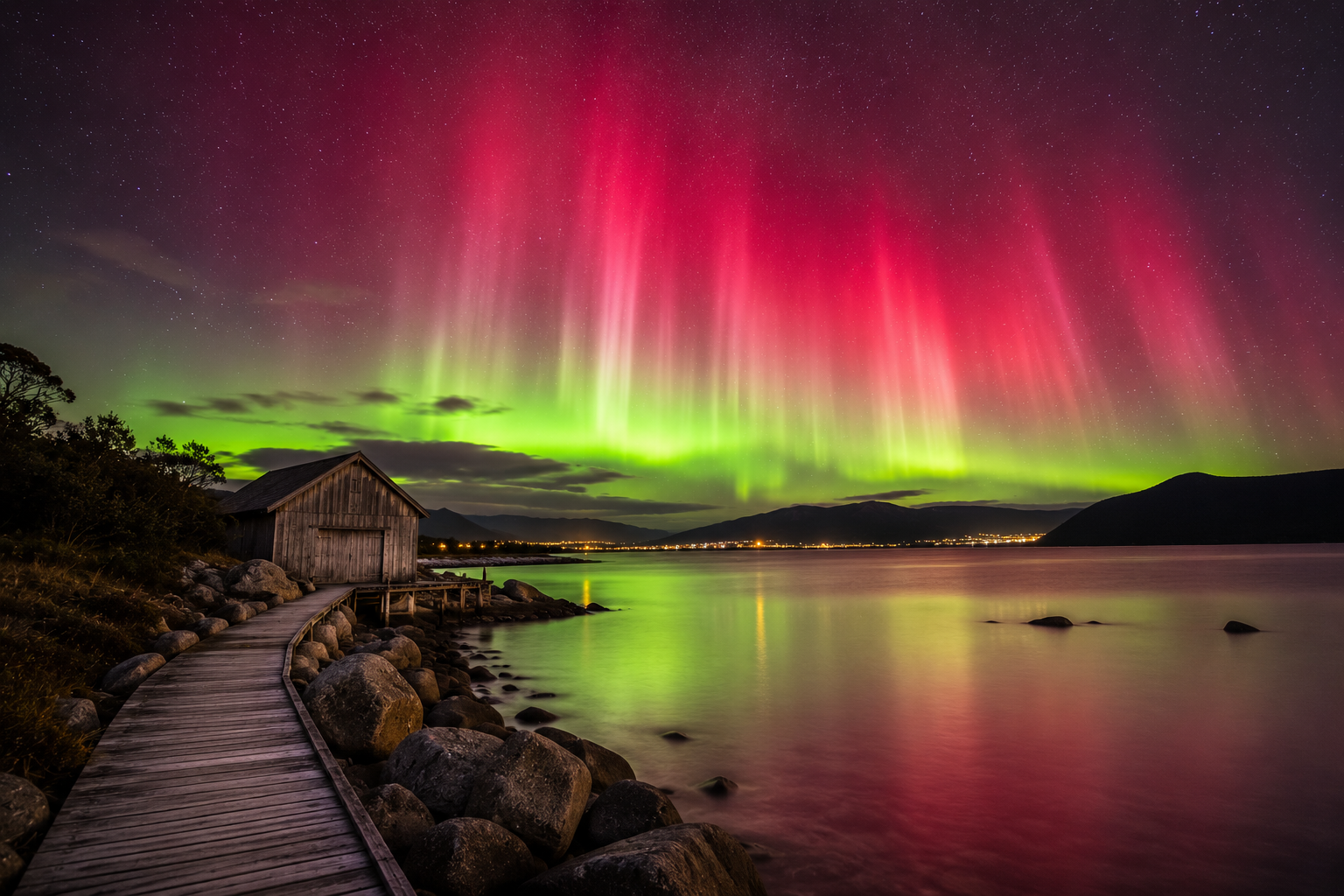
There is a particular kind of Hobart night that visitors do not expect and rarely forget: standing outside in the cold, looking south over the Derwent River, watching a faint green glow rise and fall along the horizon. Tasmania sits further south than almost anywhere else in Australia, which makes it the most reliable place in the country to see the aurora australis - the southern lights. You do not need to fly to Antarctica. You need a clear night, a reasonably dark sky, and to know roughly where and when to look.
The aurora is not guaranteed on any given night, and it rewards patience more than luck. But Hobart's geography works in your favour: south-facing water views, low light pollution in suburbs like Sandy Bay, and a winter that delivers long, dark nights from June through August. This guide covers everything you need to give yourself a genuine chance: when to go, where to look from around Hobart, how to forecast a display before you commit to standing outside at midnight, and which Island Collective property puts you closest to a clear southern sky. Across our boutique accommodation Hobart collection, two properties in particular are built with exactly this kind of night in mind.
What is the aurora australis and why can you see it from Tasmania?
The aurora australis is the southern hemisphere's equivalent of the aurora borealis the same phenomenon, caused by charged particles from the sun interacting with the Earth's magnetic field near the southern pole. It appears most often as a faint green or sometimes pink and red glow low on the southern horizon, occasionally building into bands or pillars of colour during stronger geomagnetic storms.
Tasmania's latitude is what makes it special. Hobart sits at roughly 42 degrees south, making it one of the closest major population centres in the world to the southern auroral zone. Visitors who have chased the northern lights in Iceland or Norway are often surprised to learn that Tasmania offers a genuinely comparable, if generally fainter and less frequent, southern equivalent without the multi-day flight.
The catch is that the aurora australis is usually less intense than its northern counterpart as seen from similar latitudes, and it favours long-exposure cameras over the naked eye on quieter nights. A strong geomagnetic storm can produce a vivid, unmistakable display visible to everyone outside. A moderate one might appear as a faint grey-green band that a smartphone camera picks up far more vividly than your eyes do in the moment. Both are worth chasing just calibrate your expectations accordingly.
When to see the aurora australis in Tasmania
Aurora activity itself is not strictly seasonal, geomagnetic storms can happen at any time of year. What is seasonal is darkness, and darkness is what you need to actually see the result. Here is how the seasons compare for Hobart-based aurora watching:
| Season | Months | Why it matters | Visitor note |
|---|---|---|---|
| Autumn | Mar to May | Equinox period — geomagnetic activity tends to increase | Good viewing with milder temperatures than winter |
| Winter | Jun to Aug | Longest, darkest nights of the year — peak season | Best overall chance, but pack warm layers — nights are cold |
| Spring | Sep to Nov | Second equinox period — another seasonal activity increase | Good viewing window before nights shorten into summer |
| Summer | Dec to Feb | Shortest nights of the year | Lowest odds — not impossible, but a poor season to plan around |
Winter is the clear favourite for a simple reason: more hours of darkness means more opportunities for a display to coincide with your evening. The equinox months of March and September also see a documented uptick in geomagnetic activity globally, which is why experienced aurora chasers often flag autumn and spring as genuinely competitive with peak winter. If your trip dates are flexible, aim for June through August for the best odds, or March to May and September to November as strong alternatives with milder evening temperatures.
Best places to watch the aurora australis near Hobart
Location matters almost as much as timing. You need an unobstructed view to the south, and you need to get away from Hobart's own city lights, which wash out fainter activity. Here are the most reliable spots within easy reach of the CBD and Sandy Bay:
| Location | Distance | Why it works | Notes |
|---|---|---|---|
| Sandy Bay foreshore | 10 min from CBD | South-facing river views | Walk down from The Tempo or The Helm — minimal light pollution along the water |
| kunanyi / Mount Wellington | 30 min drive | Elevated, 360-degree views | Higher altitude clears low cloud — check Pinnacle Road conditions before driving up at night |
| Goat Bluff lookout | 20 min from CBD | South-facing, popular spot | A well-known local aurora-watching location — can get busy on forecast nights |
| Tinderbox Peninsula | 30 min drive | Dark sky, south-facing coast | Further from city lights — one of the more reliable dark-sky locations near Hobart |
| Seven Mile Beach | 20 min from CBD | Open horizon, coastal | Flat horizon to the south makes faint activity easier to spot than from the hills |
| Your own backyard / hot tub | On property | No travel required | The Tempo and The Helm both have outdoor hot tubs under open sky in Sandy Bay |
The honest advantage of staying in Sandy Bay is that you may not need to go anywhere at all. Both The Tempo and The Helm have private outdoor hot tubs set under open sky, facing away from the densest part of the CBD's light pollution. The Helm's Sandy Bay accommodation sits a two-minute walk from the foreshore, and the Island Collective's accommodation Hobart hot tub offering across both Sandy Bay properties makes this kind of spontaneous midnight check entirely realistic. An aurora watch that involves warm water, a glass of something good, and zero travel time is, for many guests, the best version of this experience. You can step outside every twenty minutes to check the sky without getting dressed for the cold each time.
For guests who want a higher vantage point and are comfortable driving at night, the slopes around kunanyi / Mount Wellington offer elevation that clears low cloud sitting over the city though check Pinnacle Road conditions before committing to a winter night drive, as the upper sections can close in icy conditions.
How to forecast the aurora australis before you go outside
Standing outside on a cold night with no idea whether anything is going to happen is the single most avoidable mistake aurora chasers make. A handful of free tools tell you, with reasonable accuracy, whether tonight is worth the effort:
| Tool | What it does | Tip |
|---|---|---|
| Aurora Australis Tasmania (Facebook group) | Community-run group with real-time sightings and photos from across Tasmania | Best free, local, real-time source — join before your trip |
| Aurora Alerts apps | Push notifications based on geomagnetic (Kp) index readings | Set alerts for Kp 5 and above for a reasonable chance from Hobart |
| Bureau of Meteorology space weather | Official Australian government aurora and geomagnetic forecasting | Most authoritative source — check before committing to a late-night trip out |
| NOAA Space Weather Prediction Center | US government 30-minute and 3-day aurora forecasts, used worldwide | International source — useful for forward planning a multi-night stay |
| Clear sky / cloud cover forecast | Standard weather apps showing cloud cover for your specific location | Just as important as geomagnetic activity — cloud cover ruins even a strong display |
The practical approach: check the Bureau of Meteorology space weather page and a cloud cover forecast together each evening of your stay. If geomagnetic activity is forecast at Kp 5 or above and the sky is forecast clear after 9pm, that is a genuine green light. Set a phone alarm for a midnight check rather than staying up the whole night most strong displays last long enough to catch if you check periodically rather than waiting outside continuously.
Tips for a successful aurora watch in Tasmania
A few practical habits separate a frustrating night from a memorable one:
• Dress for much colder than the daytime temperature suggests. Winter nights in Sandy Bay or on kunanyi's slopes drop well below the CBD's daytime reading layers, a beanie, and gloves make a real difference to how long you can comfortably wait.
• Give your eyes 15 to 20 minutes to adjust to darkness before judging whether anything is visible. A faint aurora is easy to miss with eyes still adjusted to indoor light or a phone screen.
• Use your phone camera, not just your eyes, to check the sky. Smartphone night modes and long exposures pick up colour and structure that is genuinely difficult to see with the naked eye on a moderate night.
• Avoid looking at your phone screen at full brightness between checks, it resets your night vision and makes the next look less effective. Turn brightness down or use night mode.
• Check the forecast again right before you commit to going out. Geomagnetic and cloud conditions can both shift within a few hours.
• If staying at The Tempo or The Helm, the outdoor hot tub doubles as the most comfortable viewing platform in Hobart warm water, unobstructed sky, zero travel required.
Where to stay in Hobart for the best aurora viewing
Location genuinely matters for this particular experience. Here is how the four Island Collective properties compare:
| Property | Location | Aurora-relevant feature | Notes | Book |
|---|---|---|---|---|
| The Tempo | Sandy Bay | Outdoor hot tub, open sky | Closest property to the Sandy Bay foreshore — walk down for an unobstructed southern view. | View The Tempo |
| The Helm | Sandy Bay | Outdoor hot tub, open sky | Coastal setting with a clear sightline south. The hot tub makes a cold winter watch comfortable. | View The Helm |
| The District | Hobart CBD | Private indoor spa bath | CBD light pollution makes aurora viewing harder — better suited to a kunanyi or Tinderbox drive. | View The District |
| The Royale | Hobart CBD | Private indoor spa bath | Same CBD consideration as The District — pair with a short drive to a darker viewing spot. | View The Royale |
Sandy Bay is the clear choice for guests planning their trip specifically around the aurora. The Tempo and The Helm both sit in a quiet residential suburb with meaningfully less light pollution than the CBD, and both include a private outdoor hot tub under open sky the rare amenity that turns a logistically awkward midnight activity into something genuinely comfortable. For a full guide to what else the suburb offers beyond aurora season, read our Sandy Bay accommodation guide.
CBD guests staying in accommodation Hobart CBD at The District, or in luxury accommodation Hobart at The Royale, are not excluded from the experience — both properties include a private indoor spa bath, part of the Island Collective's wider Hobart accommodation with spa offering, and a short drive to Tinderbox or kunanyi puts you in range of a genuinely dark sky within 30 minutes. And for couples planning a winter trip around the aurora specifically, it is worth reading our romantic accommodation guide a clear winter night under the southern lights, finished in a private hot tub, is one of the more memorable versions of a Hobart escape.
Frequently Asked Questions
When is the best time to see the aurora australis in Tasmania?
The best season is winter, from June through August, when Tasmania's long, dark nights give you the most opportunities for a display to coincide with clear, dark sky. The equinox months of March to May and September to November are strong secondary options, with milder evening temperatures and a documented seasonal uptick in geomagnetic activity. Aurora activity itself can occur at any time of year, but darkness hours are what make winter the most practical season to plan a trip around.
Where is the best place to see the aurora australis near Hobart?
South-facing locations with low light pollution work best. The Sandy Bay foreshore, Tinderbox Peninsula, Goat Bluff lookout, and Seven Mile Beach are all well-regarded local viewing spots within 30 minutes of the Hobart CBD. Guests staying at The Tempo or The Helm in Sandy Bay can often watch directly from the property's private outdoor hot tub, which faces open sky away from the densest city lights.
Can you see the aurora australis with the naked eye?
Yes, during a strong geomagnetic storm the aurora can be clearly visible to the naked eye as a green or sometimes pink and red glow on the southern horizon. On moderate nights, it often appears fainter to the eye than it does on a smartphone camera, which picks up colour and structure more readily through longer exposure times. Checking the sky periodically with your phone camera is a reliable way to confirm activity that might be too subtle to register by eye alone.
How do I forecast the aurora australis in Tasmania?
Check the Bureau of Meteorology's space weather page or the NOAA Space Weather Prediction Center for the current geomagnetic (Kp) index forecast, alongside a standard cloud cover forecast for your specific location. A Kp index of 5 or above combined with clear skies after dark gives you a reasonable chance from the Hobart area. The Aurora Australis Tasmania Facebook group is also a useful free source of real-time local sightings and photos during active periods.
Is Sandy Bay or Hobart CBD better for aurora viewing?
Sandy Bay is the better base for aurora viewing specifically, due to lower light pollution than the CBD and several south-facing viewing spots within walking distance. The Tempo and The Helm both offering accommodation Sandy Bay Hobart with outdoor hot tubs under open sky — allow guests to watch comfortably without travelling. Guests booking accommodation Hobart CBD Tasmania at The District, or Hobart luxury accommodation at The Royale, can still see the aurora with a short 20 to 30 minute drive to a darker location such as Tinderbox Peninsula or the slopes of kunanyi.
How long does an aurora display last?
Aurora displays vary widely in duration, from brief flickers lasting a few minutes to sustained activity over several hours during a strong geomagnetic storm. Rather than waiting outside continuously, most experienced aurora watchers check the sky every 20 to 30 minutes throughout the forecast window, which is long enough to catch most displays without an uncomfortable all-night vigil.
Planning an aurora-watching trip to Hobart?
The Tempo and The Helm in Sandy Bay both offer a private outdoor hot tub under open sky — the ideal way to watch for the southern lights. Browse and book direct at theislandcollective.com.au.
No platform fees. Best rate guaranteed.